

Volume 1: The UK’s Bass Catalyst
“So, what music do you play then Kyle?”
A perfectly reasonable question for the casual music fan. For the record collector or modest selector however, it is an absolute conversational trap. You open your mouth to answer, then scramble together a clumsy, slightly pretentious string of hyphenated words:
“Well, it’s kind of Leftfield-Tribal-Post-Dubstep-Bass-bit Techno-ey... but with an Afrobeat influence.”
By the time I finish my sentence, Rebecca Leap’s eyes have completely glazed over and I’ve lost her... Hellish for promoters too, trying to figure out where to place you on the line up - particularly if you like heavy club music, yet cut your teeth in the bar industry where straight laced House and Motown are kings. Similar questions include, “What’s the name of that song mate?”, “Track ID on that repeat body vibrator?” and “Is this Afro House?” or “What was the name of that crunchy as fuck sound system destroyer you closed out with?”
Since the 2010s, a massive stream of club and dance music has evaded the marketing ploy of standard genre definitions. There were a few 2010s club music revival pages on social media in recent years, and channels created by Derek Gee and DaMetalMessiah are excellent pages for new and current music discovery. But this music I’m on about lives perfectly in the cracks between worlds - pairing the mechanical low-end weight of Western electronic production with the complex, often syncopated, spiritual rhythms of traditional global folklore.
On digital marketplaces like Discogs, metadata reading like an identity crisis: Electronic, Experimental, Leftfield, Tribal. What are we trying to describe here? We all know what House is, what Disco is—none of those words are descriptive in their nature. So why are Discogs and other platforms telling me that your music is experimental? Or from that of the leftfield? Which specific field are you referring to, exactly? House and Disco work because they are a universally understood social agreement.
There is a social agreement in place for this music, often referred to as ‘UK Bass’ - a genre with no strict borders; more of an ethos. A declaration that as long as the track respected the low end sub-bass of the British sound system heritage, the top line rhythm was free to fracture into whatever shape it it pleased. Though, as I point out, these records are still listed on platforms like discogs without the UK Bass adaptation - UK Bass, though being a broad term, fares itself better against House and Disco compared to ‘Leftfield’.
It might not seem like a big deal - it’s just music, right? But I think this is a highly academic problem.
In order to understand why this strain of music is so incredibly hard to pin down today, humour me as I attempt to refine this concept and outline the creative bottlenecks created for someone like myself and my peers. Let’s take a look at the exact moment the traditional lineage of UK electronic music completely shattered. Here I’ll map out how the dark, meditative bass of late-2000s London mutated into the aggressive, technical “drum workouts” of modern techno, with specific examples picked from my record collection.
The Hardcore Continuum Deficit: The Missing 2000s Chapter
By now we know that the rave phenomenon of the 90s and early 00s was something to behold. Before we had the assortment of documentaries doing the rounds, The Wire and Simon Reynolds, a renowned music journalist, managed to provide excellent commentary on the idea of the Hardcore Continuum - it namely being “a particular set of relations based around pirate radio, dubplates, raves and record shops” here in the UK. This lineage was intact for a very long time, and in my opinion you could go as far back as street soul or e-soul, as DJ idols like Luke Una or Charlie Dark have opined on so many times.
If we do go back as far as the early 80s, it’s a generational baton-pass of UK soundsystem culture (preceding Lovers Rock, Acid House, Bleep etc): Hardcore Rave (1992), Ambient Jungle (1994), The State of Drum and Bass (1995), Two-Step Garage (1999), and Grime (and a little Dubstep) (2005). Those terms are the name to Reynolds’ articles and they show that it was a straight line driven by pirate radio and community rave culture.
But by the late 2000s and early 2010s, the continuum hit a wall. It didn’t just evolve; it completely shattered. As the underground music forums of the era like 555-5555 fiercely debated, the linear, chronological highway of UK rave music had fractured into a decentralized root network thanks to the internet. Skream, Benga, and Artwork made it to the festival circuit - seeing them at Reading Festival in 2010, absolutely cooked, was an interesting experience. Kano was also appearing in music videos dressed like a member of One Direction while wearing the Kanye sunglasses made famous from the 2008 Graduation campaign. The British club underground was knee-deep in its identity crisis. Some would argue that BBC Radio 1Xtra’s radio roster of the time was the start of this decline; others would say this happened when Boiler Room arrived.
As the original dubstep scene in Croydon became formulaic and co-opted by the mainstream (eventually forming into Brostep), a group of young producers stopped following the linear path that came with big branding. Instead, they began cross-pollinating the heavy bass pressure of London with sweeping emotion; a bright two-chord organ progression from Hyph Mngo, among other sound additions that were not formally part of the prior musical formulas. Fusion cuisine.
Journalists, lacking the vocabulary to describe it, lazily slapped on the term “Post-Dubstep”. If we think of “Post-Dubstep” being the lazy corporate name for the Croydon scene deconstructing itself, then “UK Bass” was the living, breathing reality of what came next. It was the birth of labels like Hessle Audio, Livity Sound, Hemlock, and Swamp81. These labels capitalised on the structural freedom of the bass music umbrella and brought us some of the most exciting club music I’ve ever heard. UK Club music was now so broad that you could find it’s influence in niche areas of YouTube, blog culture took it’s fair share too and some producers even took a more classical approach to making electronic music during this era. Personally, I was more excited by the stripped back skeletal side of this; the drums. 3+ hours of music in a club should be about tension and release, and a proper drum tool, deployed at the right time, are hypnotic pallete cleansers crucial to course of the night. To trace this particular fracture, I’ve picked out two items from my collection - one is a classic, now very expensive 12” cut of cult status, and the other is a mix CD courtesy of the FabricLive CD mix series:
Mala – Anti War Dub (2006): This represents the absolute peak spiritual weight of the original continuum. It is a dub-wise prayer designed for the meditative, sub-heavy church of the legendary DMZ club nights. It is deep, smoke-filled, half-step, and rooted heavily in Jamaican soundsystem tradition.
Shackleton – Fabric 55 (2010): For me, hearing Shackleton’s work was like experiencing a séance for the first time - listening to this CD at max volume in my Mazda 3 was insane! He took that sub bass architecture of dubstep but completely stripped away the traditional, predictable half-step rhythm. In its place, he injected a manic, paranoid, dizzying percussion network. For me, this was the precise moment UK Bass music stopped feeling like Jamaica; there were no slick R&B-style vocals from the UKG heyday anymore; it sounded more like music I imagine being played at a hippy drumming circle, but the hippies themselves are robots. Shackleton is widely cited in musicology as the bridge between traditional UK bass weight and what Reynolds calls “Scorched-Earth Tribalism.”
Bringing the Arc to 2020: How Pandemic Claustrophobia Accelerated the Underground Tempo
As I mentioned above, I have a real soft spot for this period of club music and culture. Labels like Whities (now, AD27), Young Turks, Dekmantel, Version, Time Dance had all entered the ring. It really was like peak Attitude Era WWE, but in underground music form. I was galavanting up and down the country and Europe, lucky enough to go and learn from DJ’s and Selectors I’d know would play a good amount of this music. By 2015, this percussive mutation had fully evolved into what the underground began calling the “drum workout” - a niche, within a niche, the melody of these tunes are completely dead. Chord progressions, non-existent. The music relied entirely on pure, rhythmic tension. The ultimate turning point came with the release of Randomer’s Kids Play EP - specifically the B-side weapon, “Juju”.
Going back to my pallete cleanser comment, these tunes are the engine of a club night and any decent party. They aren’t “songs” in a traditional sense; often broken, heavy, raw and complex in rhythmic structure. A good example of this is the opening track of Tim Reaper b2b Sherelle’s London Bridge broadcast on the fabriclondon YouTube channel - literally titled ‘Percussive DJ Tool’, here it is utilised as an introduction to a fast paced mix running at 160bpm and upward. The broadcast aired in April 2021 but by this point there was already a steady strain of this faster paced club music, compared to the norms of the decade before - bass music didnt automatically end up where it is now. It was a gradual experimentation of a growing group of music producers. It was Munich’s Skee Mask who proved to me that these rhythmic experiments had a long-term, mature future. His landmark Compro LP from 2019 had garnered cult like status among listeners on radio stations like NTS - FlybyVFR being a tune I heard played so many times during my work from home mornings. An artist whose music is well-known for its inducing of the “where do I categorise this?” in the grand scheme of things, it was the ISS005 release in 2020 that perfectly mirrored this. Showing his philosophy of treating electronic sub-genres not as rigid rules, but as modular puzzle pieces.
Take the two standout tracks from that release:
• “IT Danza”: A gem of a track. The absolute pinnacle of modern mechanical tribalism. In a similar vein to Shackleton, Skee Mask breaks entirely away from standard electronic loops, utilising a fractured, kinetic drum programming structure that at times feels anxiety inducing. A frantic tap dance or avant-garde jazz workout. A similar feeling to the horns heard during one of Theo Parrish’s marathon DJ sets. Yet the distinct bass weight anchoring it all firmly in place by the rounded heavy kick drum.
• “Reefer Madness”: A masterclass in genre-blurring. The unmistakable fusion of the dark, room-shaking bass pressure of classic 2006 dubstep with a rapid, constantly shifting 1990s breakbeat rhythm.
Skee Mask (from Munich), releasing music that pulls from London dubstep, Bristol bass, and Detroit house, proves that the continuum is no longer a British highway. It is a digital code shared globally. Both tracks sitting comfortably at 140bpm, the frenetic pace of music production during this era - literally, and figuratively(!), saw a swathe of releases showcasing this club music within the 140-160bpm range, as touched on earlier. Producers from other continents also now weighing in on this smorgasbord of club music culture. Labels like Awesome Tapes From Africa, GQom Oh!, Nyege Nyege Tapes were bringing to the world stage their own take on electronic music mutation. Genres like Amapiano, Singeli and Kuduro all stamping their place in dancefloor ritual. Over in South America producers like Badsista, Dengue Dengue Dengue and Florentino’s tunes could all be heard regularly on radio stations like RinseFM.
One can see here then how the idea of the Hardcore Continuum, once a localized, linear progression of UK soundsystem culture, could now be challenged some 20 years since the last articles by Reynolds*. Today’s well connected global landscape renders the concept of a strictly localized, genre-bound evolution obsolete, transforming it into a borderless, worldwide dialogue driven by instant, universal access to sonic sub-genres. Kassian have been producing fast paced techno utilising log drum elements that makes Amapiano so distinct, as an example.
*While Reynolds’ original formulations focussed strictly on the linear, localised UK rave highway, his late 2019 commentary on the rise of “Conceptronica” tracks the rise of abstract, high-art studio fetishism. Skee Mask’s catalog sits right on the fault line of this shift. His landmark 2018 Compro LP was recently spotlighted by Anthony Fantano in his IDM/Leftield starter pack, cementing its status as modern classic.
The “Boiler Room Effect” Distortion
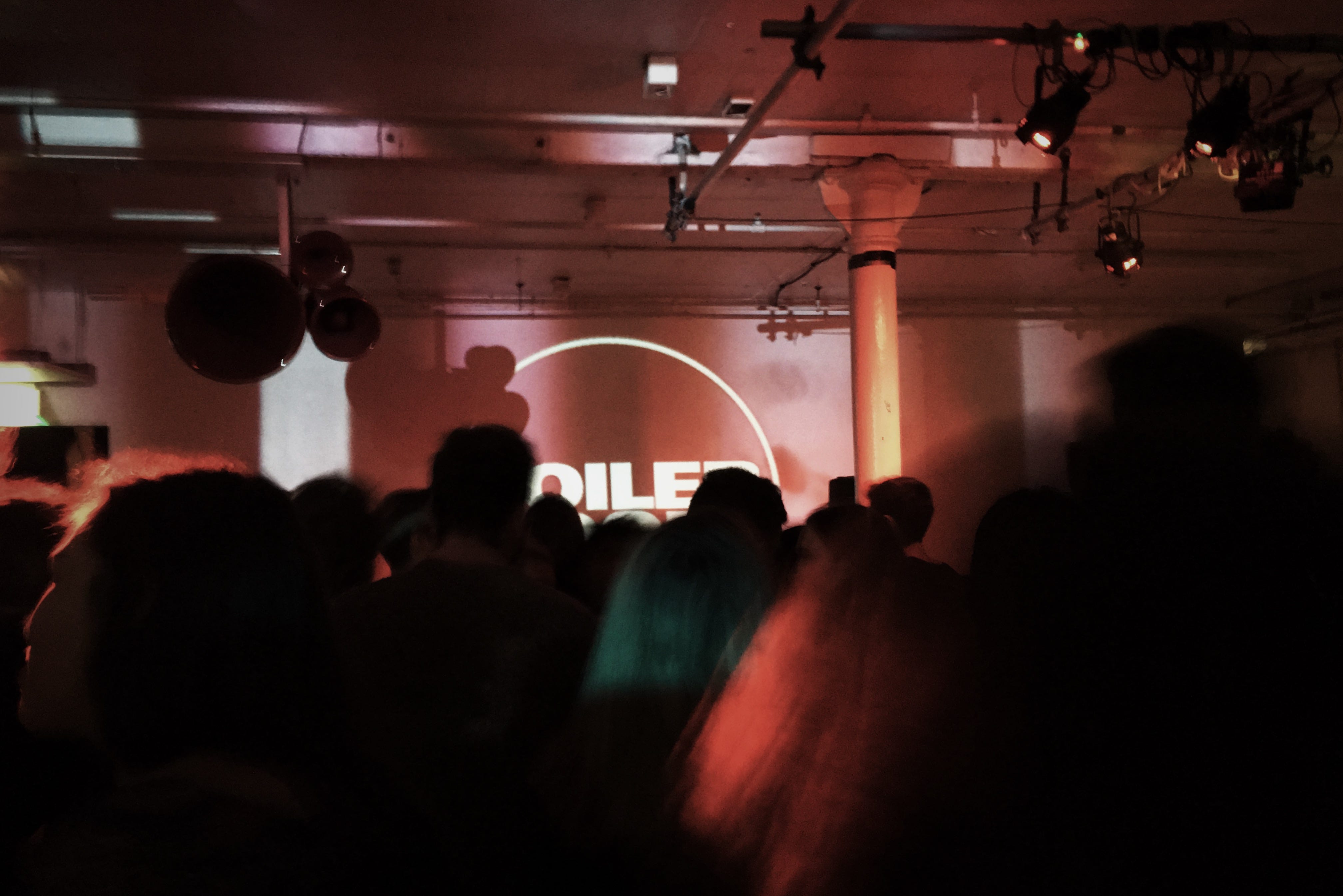
Coincidentally, the rise of this stripped-back, mechanical tribalism perfectly aligned with a major technological shift in how we consumed club culture: the global dominance of Boiler Room. Launched in 2010, Boiler Room did something radical by turning the DJ booth inside out and putting the crowd’s physical reaction on a screen for millions of viewers at home. When it came to showcasing the raw power of these drum workouts, and the various flavours of club music in general, Boiler Room became the ultimate lens, transforming the music through three distinct cultural mechanics:
The Zoom-In on Syncopation: Before Boiler Room, a track like Randomer’s “Juju“, or O’Flynn’s drum tool big at the time “Tyrion”, was experienced exclusively in pitch-black, smoke-filled clubs like Plastic People. Before the pretension that arose circa 2016 onwards, Boiler Room brought high-definition cameras directly over the decks and inches from dancers’ faces. Those early uploads were so raw in their capture that audiences at home could visually see the crowd physically struggle to find the downbeat in a complex, shifting drum pattern right before the heavy sub-bass dropped to anchor them. That’s if you were paying attention during the broadcast and didn’t just have it on during pre-drinks with your pals. It turned the evolution of escapism into a compelling spectacle.
The Crowd Reaction Economy: There were tons of viral video footage on Facebook during this time showing a commodification of the “rewind” and the peak reaction moment—such as Tasker spinning back MCDE’s copy of Juicy Sushi, or the crowd’s general vibe on those early recordings from the coverage of Dekmantel festival, DJ EZ’s moment, etc. While the ideas of Boiler Room’s online lifestyle influence and drum workouts are separate, these usually unspoken rhythmic tools are built like weapons. When a DJ drops a track that strips away all melody and leaves nothing but a pounding 909 kick and a wooden percussive loop, the visible chaos in the crowd footage proved that this intense minimalism is actually some of the most high-energy music on earth.
Shifting the DJ’s Role to Priest like Shaman: By placing the DJ directly in the centre of a dense, interactive circle rather than on a distant, elevated stage (as seen in the Disco days of Paradise Garage), the platform visually restored the DJ to the ancient role of a tribal leader or electronic shaman guiding a communal, physical ritual. I often think of those pentecostal church ceremonies with everyone running up and down the isle shaking and screaming. Reynolds spoke of this phenomenon in Energy Flash in 1998, linking how the “combination of repetitive, hypnotic loops and ecstatic communal energy mimics ancient pagan rituals”. A stark contrast to the late 70s and 80s where the DJ was typically screened off or hidden albeit performing the same act.
The Medium of Discovery Dictates the Category
The reason the ‘drum workout’ dominated the digital lens so vividly is purely down to the medium of the time. The 2010s was the peak of internet club culture capitalisation. A Boiler Room set thrives on high-energy, physical shifts in rhythm. A stark, modular drum loop shifting patterns at 130 BPM (DJ EZ, Yung Singh etc) creates an instant, visual (and audible) reaction in a crowded room. A five-minute ambient jazz chord progression doesn’t translate the same way on a screen. Today the overall music scene has taken things many steps further with the advent of channels like My Analogue Journal and it’s textured bohemian aesthetic; but more on that in part 3.
The virality of early Boiler Room tended to fetishise the heaviest, most aggressive ‘bangers’ because those were the tracks that made crowds lose their minds on camera; yet, all these one off edits and VIP’s completely discounts the beautiful, melodic, and deeply musical side of this exact same scene. Because this movement was inherently genre-less, it did not have a single rulebook. It naturally allowed artists like Floating Points and Joy Orbison to run a parallel path of heavy emotion and gorgeous harmony.
The Co-Existence of Beautiful Melodies: Sam Shepherd (Floating Points) has been a staple of this scene since it’s inception, and still is, yet he was also releasing tracks like Elaenia in 2015 and Kuiper, a follow up in 2016. Both on his own imprint Pluto, these are lush ambient tunes, with jazz inflected chord progressions and the sweeping synth work on Kuiper is like something out of a film score. Alongside him, Peter O’Grady better known as Joy Orbison arguably kick started all this with Hyph Mngo and is one of the most notorious in the scene to this day. His tracks are well known for being functional club weapons turned into anthems - Ellipsis in 2014 or his visceral collaborations with Boddika mostly rely on soaring, soulful and melancholic vocal chops - a production style I’m really fond of this scene for. Tune’s like Hackney Parrot are the perfect example, albeit by a different producer. The drum workouts I spoke of earlier was still alive and thriving throughout all of this, but now you also had labels like Hessle Audio taking things even further with the release of deeply strange music like Ploy’s “Sala One Five” - an abstract techno bobbler; a tune like this has a similar impact during, say, the earlier hours of the club night; when things haven’t gone full tilt yet. These like minded labels and producers were essentially bringing a Selectors ethos to what had become a very young scene - essentially teaching new DJ’s, club goers and the like that there is a discipline that needs to be respected when programming music in this way. The sounds and technology were new, but you had to maintain elements of the lineage that played a part in mutating the sound, and culture, to where it is today.
The Leap to YouTube: It was also on YouTube where the melodic fracture of this genre-less culture was thriving. Channels like Eton Messy and Majestic Casual had started emerging, uploading songs from relatively unknown artists relying heavily on aspirational, highly polished indie-pop, “messy but expensive” lifestyle in the imagery, eventually leading us to the viral DJ set by Alison Wonderland on Mixmag some 11 years ago. The two channels acted as major launchpads for the commercial UK house and future-bass boom of 2012–2015 (think Disclosure, Bondax, and FKJ). They curated music designed to transition seamlessly from a bedroom laptop to a mainstream festival mainstage. For me this was the first sign of music being sold as a ‘vibe’ or ‘atmosphere’ - the lo-fi house scene, hugely popular on the tumblr blogging circuit, had not existed yet. I had placed the production of artists like Floating Points and Burial also into this camp for during my music discovery of that period - the stories of these individuals weren’t as wide spread as they are today. The Majestic Casual and Eton Messy era acted as its own microcosm for what was happening in the wider electronic music scene - artists like Bondax whose early work could be found on platforms like Myspace, inadvertently gave birth to the ‘algorithm vs tastemaker’ paradigm - the underground had to flee this space because the “vibe” became corporate, diluted background music… eventually leading us to Spotify’s ‘Chill House’ playlist, but for at least two years this music was the mainstay of places like Tumblr and online forums.
For The Heads: This exact aesthetic bottleneck birthed its own underground digital counter-curation. Helmed by tastemaker Ian DPM, platforms like Definite Party Material helped carve out a vital space on the fringes of the internet as a pure archive ‘for the heads’. Dodging the polished lifestyle setups of mainstream music vloggers, the channel relies on a less is more ethos to showcase specific, blistering club music on the fringes of boundary pushing. It treats the tracklist not as a well polished playlist, but as a ‘enter if you dare’ for brave selectors looking for exclusive track ID’s, providing a reliable platform for the underground. Boiler Room were well known for tracklist gatekeeping in the comment section - to this day you’ll see on the older broadcasts “Get the full tracklist at: https://blrrm.tv…” yet I’ve never once actually seen a tracklist on their website.
Platforms like YouTube, Tumblr and internet forums were vital during this period and, as evidenced above, often grouped things by visual aesthetic rather than strict tempo or geographic scene. It made total sense for 21 year old me to bundle the melancholic, rainy-day texture of Burial & Four Tet’s “Moth” into the same mental “vibe” folder as Majestic Casual - I had no idea how deep the history would run when I eventually started reading up on them more and more. Could we say then that the medium of music discovery dictates how we categorise this in the human brain? There was a lot going on around this time - it would be remiss of me not to mention Feel My Bicep’s blog in this mixture of club culture of the 2010’s too. An underground MP3 sharing space originally hosted on Blogspot, the flavour here was dusty 90s house chords and obscure Italo disco for the heads. This blog-house energy collided head-on with everything I mentioned above; it truly was a golden era for club music.
The Structural Matrix: Why Is It So Hard to Categorise?
Ok, let me get my white board out and break down the structural architecture of track layouts. Remember, Jake from Accounting asked me what music I play. When you compare UK Bass to mainstream genres, you quickly see that it purposefully sits right in the cracks of the grid:
┌───────────────────────────┐ │ [ MAINSTREAM TECH HOUSE ] │ └─────────────┬─────────────┘ ▼ • Standard 4/4 Kick • Static, Linear Loops • Predictable Energy ───────────────────────────── ┌───────────────────────────┐ │ [ TRADITIONAL JAZZ / GLOBAL POLYRHYTHMS ] │ └─────────────┬─────────────┘ ▼ • Organic Polyrhythms • Live Instrumentation • Cyclical, Shared Flow ═════════════════════════════ ┌───────────────────────────┐ │ [ UK BASS ]│ └─────────────┬─────────────┘ ▼ Fuses the mechanical loops of Techno with the complex, syncopated off-beat soul of Jamaican Dub, UKG, Grime, Dubstep, and Kuduro ad infinitum.
Mainstream Tech House - let’s take Maya Jane Coles’ remix of 4th Measure Men’s 4 You as an example;
The structure relies on a highly predictable, static loop with a rigid 4/4 kick drum and call and response vocal sample. It is linear, safe, and easily packaged by streaming algorithms or festival programmers for mass consumption.
Afrobeat, Traditional Global Rhythms and, most importantly, Jazz, are built on highly complex, layered polyrhythms, syncopation, and call-and- response dynamics.
It is cyclical and deeply participatory. Tony Allen, Fela Kuti, Ezra Collective.
The Genreless Matrix Means Total Variation. When you mix London sound-system bass, Detroit techno, Chicago house, and UK garage, you aren’t creating a new genre with strict borders. You’re creating a sandbox. Because of this, one producer might focus purely on the polyrhythms of UK Funky, resulting in a stark, tribal “drum workout” (think early Livity Sound or Untold, Seiji on the “Broken Beat” end of things). Another producer might take the exact same ingredients but focus on the soulful, chord-heavy legacy of Detroit techno and garage, resulting in something deeply melodic like Leon Vynehall’s Music for the Uninvited in 2014. Both belong to the same scene, play the same club nights, and buy each other’s records, but their music sounds completely different. The UK Bass “Drum Workout” strips away the predictable tech-house template but keeps the raw, mechanical electronic texture of techno. Then, it injects the dizzying, off-beat syncopation of traditional afro-rhythms or dancehall patterns. Because it lives perfectly in the tension between Western, grid-based studio techno and complex global syncopation, standard music terminology completely breaks down. It is too techno for the ‘World Music’ crowd, and too polyrhythmic for the standard tech-house clubber.
In Vol. 2 of “What Genre Is This, Actually?”, we are leaving the dark UK club rooms behind and traveling directly to the source. We will dig deep into the un-remixed folklore roots, exploring how labels like Sofrito, Kalita, and Awesome Tapes From Africa archive the sacred rhythms of church, community rejoice, and global heritage.