
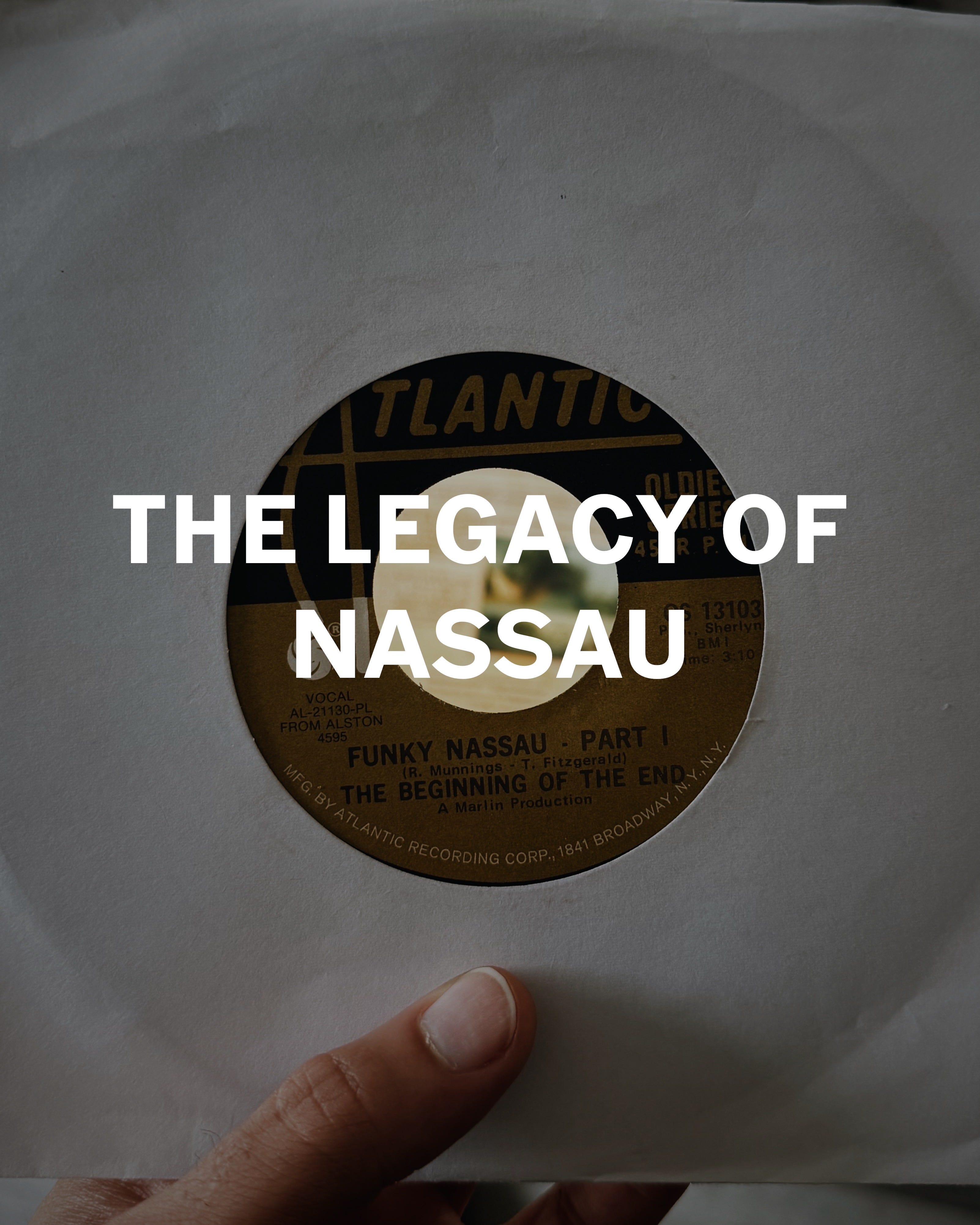
The Original: The Beginning of the End – "Funky Nassau" (1971) - Traditional Bahamian Junkanoo beat collided with raw American funk. Reaching #15 on the Billboard Hot 100, the root breakbeat went on to be sampled endlessly in the 90's
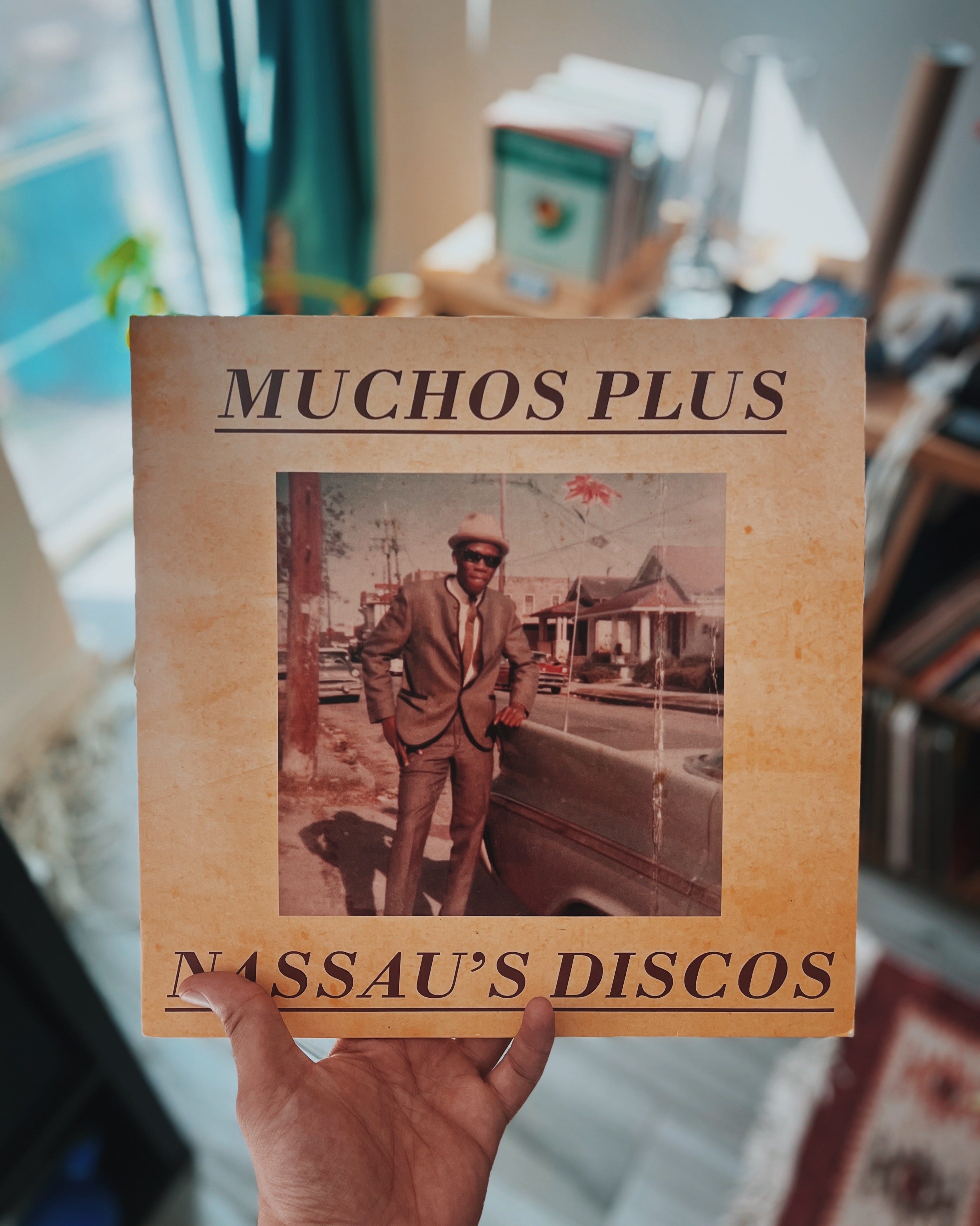
The Cover version: Muchos Plus – "Nassau's Discos" (1979) - a holy grail reissue by Kalita Records of a rare cover version titled "Nassau's Discos". Led by Jamaican-born musician Rudy Mills, Muchos Plus was a New Orleans-based outfit made up of Panamanian, Honduran, and local musicians.
A1 + B1 Nassau's Discos (Long & Short Version) - a heavy, unquantized tropical disco cover originally pressed in a microscopic run on his own private U-Solo Records label, selling for a peak £500 on discogs!
B2 Love Misunderstood - a perfect, late night antidote. The second half contains a lush horn-laced funk breakdown.
Further below is an excerpt from the cover art.
This is just one thread of a borderless soundsystem dialogue. In 2 weeks, Vol. 1 of 'What Genre Is This, Actually?' drops on Substack, tearing apart standard genre definitions. Hit the link in my bio to join the inner circle
Shout out to Chris & also Zaf (Love Vinyl) for the excellent pressing and getting this music out there!
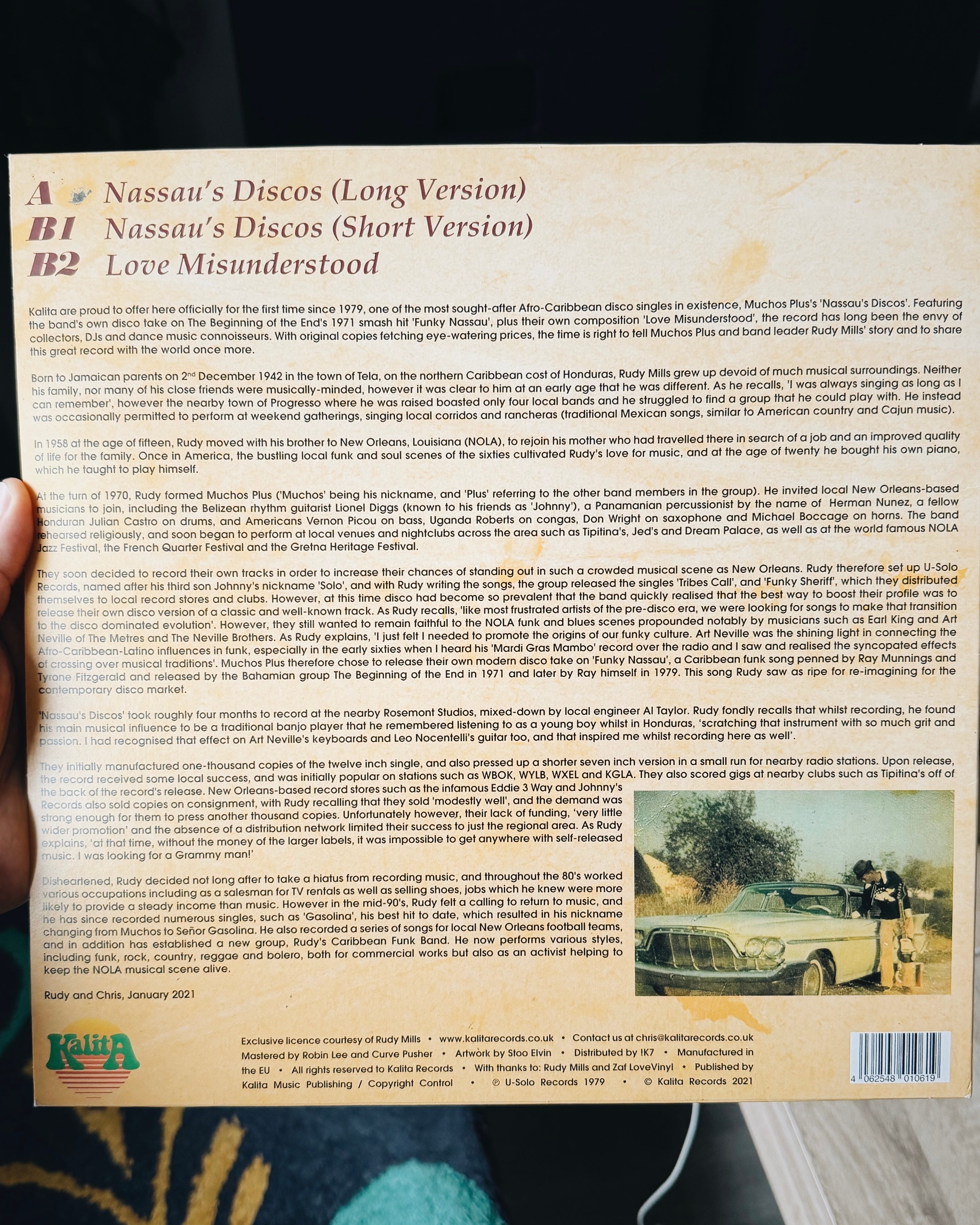
Kalita are proud to offer here officially for the first time since 1979, one of the most sought-after Afro-Caribbean disco singles in existence, Muchos Plus's 'Nassau's Discos'. Featuring the band's own disco take on The Beginning of the End's 1971 smash hit Funky Nassau', plus their own composition 'Love Misunderstood", the record has long been the envy of collectors, DJs and dance music connoisseurs. With original copies fetching eye-watering prices, the time is right to tell Muchos Plus and band leader Rudy Mills story and to share this great record with the world once more.
Born to Jamaican parents on 2 December 1942 in the town of Tela, on the northern Caribbean cost of Honduras, Rudy Mills grew up devoid of much musical surroundings. Neither his family, nor many of his close friends were musically-minded, however it was clear to him at an early age that he was different. As he recalls, was always singing as long as ! can remember, however the nearby town of Progresso where he was raised boasted only four local bands and he struggled to find a group that he could play with. He instead was occasionally permitted to perform at weekend gatherings, singing local corridos and rancheras (traditional Mexican songs, similar to American country and Cajun music).
In 1958 at the age of fifteen, Rudy moved with his brother to New Orleans, Louisiana (NOLA), to rejoin his mother who had travelled there in search of a job and an improved quality of life for the family. Once in America, the bustling local funk and soul scenes of the sixties cultivated Rudy's love for music, and at the age of twenty he bought his own piano, which he taught to play himself.
At the turn of 1970, Rudy formed Muchos Plus (Muchos' being his nickname, and "Plus' referring to the other band members in the group). He invited local New Orleans-based musicians to join, including the Belizean rhythm guitarist Lionel Diggs (known to his friends as "Johnny), a Panamanian percussionist by the name of Herman Nunez, a fellow Honduran Julian Castro on drums, and Americans Vernon Picou on bass, Uganda Roberts on congas, Don Wright on saxophone and Michael Boccage on horns. The band rehearsed religiously, and soon began to perform at local venues and nightclubs across the area such as Tipitina's, Jed's and Dream Palace, as well as at the world famous NOLA Jazz Festival, the French Quarter Festival and the Gretna Heritage Festival.
They soon decided to record their own tracks in order to increase their chances of standing out in such a crowded musical scene as New Orleans. Rudy therefore set up U-Solo Records, named after his third son Johnny's nickname 'Solo', and with Rudy writing the songs, the group released the singles Tribes Call, and 'Funky Sheriff, which they distributed themselves to local record stores and clubs. However, at this time disco had become so prevalent that the band quickly realised that the best way to boost their profile was to release their own disco version of a classic and well-known track. As Rudy recalls, 'like most frustrated artists of the pre-disco era, we were looking for songs to make that transition to the disco dominated evolution'. However, they still wanted to remain faithful to the NOLA funk and blues scenes propounded notably by musicians such as Earl King and Art Neville of The Metres and The Neville Brothers. As Rudy explains, I just felt I needed to promote the origins of our funky culture. Art Neville was the shining light in connecting the Afro-Caribbean-Latino influences in funk, especially in the early sixties when I heard his Mardi Gras Mambo' record over the radio and I saw and realised the syncopated effects of crossing over musical traditions. Muchos Plus therefore chose to release their own modern disco take on Funky Nassau", a Caribbean funk song penned by Ray Munnings and Tyrone Fitzgerald and released by the Bahamian group The Beginning of the End in 1971 and later by Ray himself in 1979. This song Rudy saw as ripe for re-imagining for the contemporary disco market.
"Nassau's Discos' took roughly four months to record at the nearby Rosemont Studios, mixed-down by local engineer Al Taylor. Rudy fondly recalls that whilst recording, he found his main musical influence to be a traditional banjo player that he remembered listening to as a young boy whilst in Honduras, 'scratching that instrument with so much grit and passion. I had recognised that effect on Art Neville's keyboards and Leo Nocentelli's guitar too, and that inspired me whilst recording here as well'.
They initially manufactured one-thousand copies of the twelve inch single, and also pressed up a shorter seven inch version in a small run for nearby radio stations. Upon release, the record received some local success, and was initially popular on stations such as WBOK, WYLB, WEL and KGLA. They also scored gigs at nearby clubs such as Tipitina's off of the back of the record's release. New Orleans-based record stores such as the infamous Eddie 3 Way and Johnny's Records also sold copies on consignment, with Rudy recalling that they sold 'modestly well, and the demand was strong enough for them to press another thousand copies. Unfortunately however, their lack of funding, 'very little wider promotion' and the absence of a distribution network limited their success to just the regional area. As Rudy explains, 'at that time, without the money of the larger labels, it was impossible to get anywhere with self-released music. I was looking for a Grammy man!'
Disheartened, Rudy decided not long after to take a hiatus from recording music, and throughout the 80's worked various occupations including as a salesman for TV rentals as well as selling shoes, jobs which he knew were more likely to provide a steady income than music. However in the mid-90's, Rudy felt a calling to return to music, and he has since recorded numerous singles, such as 'Gasolina", his best hit to date, which resulted in his nickname changing from Muchos to Senor Gasolina. He also recorded a series of songs for local New Orleans football teams, and in addition has established a new group, Rudy's Caribbean Funk Band. He now performs various styles, including funk, rock, country, reggae and bolero, both for commercial works but also as an activist helping to keep the NOLA musical scene alive.
Rudy and Chris, January 2021